
AP Biology Tutoring in Ontario | May Exam Preparation
Overview of AP Biology Tutoring in Ontario | May Exam Preparation
Overview of AP Biology Tutoring in Ontario
AP Biology Tutoring: Ontario Support for the College Board Exam
AP Biology is designed to match an introductory university biology course. Students must go beyond recalling terms and pathways. They are expected to analyze experiments, interpret data, work with simple statistics and write clear scientific explanations. For families in York Region and across Ontario, AP Biology tutoring offers a structured way to build content knowledge, sharpen data skills and prepare for the May exam.
The course is content heavy, but the exam rewards reasoning more than memorization. A student who knows the Krebs cycle steps but cannot explain what a changed enzyme concentration does to a graph will lose marks. Our approach to AP Biology tutoring focuses on connecting content to evidence and expressing that connection in precise written answers.
How AP Biology Fits with Ontario Biology Courses
AP Biology is a College Board course, so it does not carry an Ontario Ministry course code. Students usually take it alongside or after Ontario biology, and the overlap is substantial. Grade 11 Biology (SBI3U) introduces diversity, evolution, genetics and cellular processes, while Grade 12 Biology (SBI4U) develops biochemistry, metabolic processes, molecular genetics, homeostasis and population dynamics.
The AP course goes further in depth and in experimental reasoning. Students are asked to design investigations, evaluate evidence and apply mathematical routines that are not emphasized in the Ontario courses. Students in the IB stream can also review our Grade 12 IB Biology tutoring page to compare the two pathways.
Understanding the AP Biology Exam
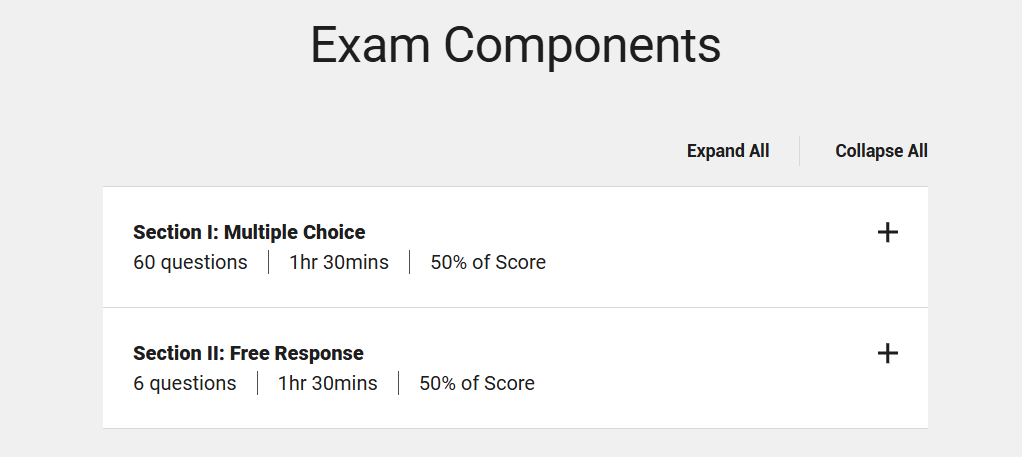
The exam lasts 3 hours and is written in May. Both sections count for 50% of the score, and results are reported on a scale of 1 to 5.
Section I: Multiple Choice. 60 questions in 90 minutes, completed digitally on the Bluebook app. Many questions are tied to a shared stimulus such as a graph, table or experiment, with several questions per set.
Section II: Free Response. 6 questions in 90 minutes, answered by hand in a paper booklet. There are 2 long questions and 4 short questions.
Calculators are permitted on both sections, and students are given reference information, so success depends on applying the relationships, not memorizing them.
The Eight Units of AP Biology
The College Board publishes an exam weighting range for each unit on the multiple-choice section.
- Unit 1, Chemistry of Life (8 to 11%): Water, macromolecules, and the link between structure and function.
- Unit 2, Cell Structure and Function (10 to 13%): Organelles, membranes, transport, and the relationship between surface area, volume and cell size.
- Unit 3, Cellular Energetics (12 to 16%): Enzymes, cellular respiration and photosynthesis.
- Unit 4, Cell Communication and Cell Cycle (10 to 15%): Signal transduction, feedback, mitosis, meiosis and regulation of the cell cycle.
- Unit 5, Heredity (8 to 11%): Mendelian and non-Mendelian inheritance, linked genes, pedigrees and chi-square analysis.
- Unit 6, Gene Expression and Regulation (12 to 16%): DNA replication, transcription, translation, regulation, mutation and biotechnology.
- Unit 7, Natural Selection (13 to 20%): Evolution, population genetics, Hardy-Weinberg, speciation and phylogenetics. This is the most heavily weighted unit.
- Unit 8, Ecology (10 to 15%): Energy flow, population and community dynamics, and responses to environmental change.
Core Skills Students Must Execute
1. Explaining Concepts and Processes
Students must explain biological processes at the level of mechanism, not simply name the steps.
Describing how structure determines function from molecule to organism. Explaining how enzymes, membranes and signalling pathways respond to changing conditions. Linking cellular events to whole organism outcomes.
2. Data Analysis and Graphing
Graphs and tables appear throughout both sections of the exam.
Reading trends, identifying relationships between variables and predicting outcomes. Constructing properly labelled graphs from raw data. Calculating and interpreting standard error and error bars.
3. Mathematical Routines
AP Biology uses focused calculations that students can master with practice.
Using chi-square to test genetic hypotheses. Applying the Hardy-Weinberg equations to population data. Calculating water potential, rates, percent change and surface area to volume ratios.
4. Experimental Design
Free-response questions regularly ask students to evaluate or design an investigation.
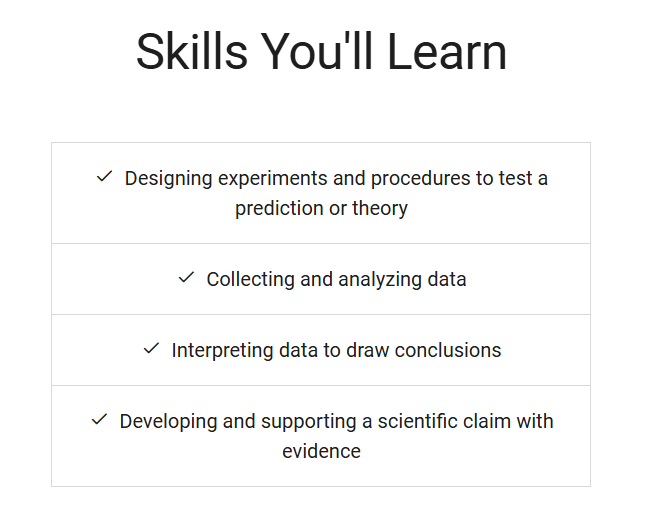
Identifying independent and dependent variables, controls and sources of error. Writing testable hypotheses and predicting results. Justifying conclusions with evidence and explaining what would strengthen them.
5. Connecting Across Units
The exam rewards students who see biology as one connected system.
Linking energy flow from photosynthesis through ecosystems. Connecting gene expression to phenotype and then to natural selection. Applying evolutionary reasoning to cell level and population level questions.
Mastering the Free-Response Section
Free-response questions reward complete, precise answers that use the command term in the prompt. A response that only names a concept will earn far fewer marks than one that explains it and ties it to the data.
Our tutors help students:
Use Command Terms Correctly: Distinguishing between describe, explain, justify, predict and calculate so that each answer matches what is asked.
Write Claim, Evidence and Reasoning Responses: Building concise explanations that connect data to biological principles.
Practise with Released Questions: Working through past College Board free-response questions with official scoring guidelines, then reviewing each response with a tutor.
Manage Time: Practising the pacing needed for two long and four short questions in 90 minutes.
Multiple-Choice Strategy and the Digital Format
Because Section I is completed digitally, students benefit from practising in a format that matches exam day. Our sessions include timed blocks of stimulus based questions, strategies for reading graphs quickly and techniques for eliminating weaker answer choices.
When Should Students Write AP Biology?
Most Ontario students write the exam in May of Grade 12, after completing SBI4U, because SBI4U covers much of the AP content in biochemistry, metabolism, molecular genetics and population dynamics. Strong Grade 11 students can also write it after SBI3U, though they will need to learn additional units through an AP course at school or independent study. Students should contact their school’s AP coordinator early in the year, since registration closes well before May.
Many universities recognize strong AP scores for credit or advanced standing, though policies vary by institution and program, so families should confirm details with the universities their child is considering.
AP Biology Tutoring: Personalized Support for Ontario Students
Whether your child is taking AP Biology at school, studying independently or pairing it with an Ontario biology course, targeted tutoring can build the reasoning, data skills and exam habits the College Board looks for.
We offer online tutoring for students anywhere in Ontario, and in-person sessions at our Markham Tutoring Center.
Contact York Region Tutoring today to learn more about our AP Biology tutoring and how we can support your child through the May exam.


AP Biology Course Content
Topics may include:
- Structure of water hydrogen bonding
- Elements of life
- Carbohydrates
- Lipids
- Nucleic acids
- Proteins
Topics may include:
- Cellular structure and functions
- Cell size
- Cellular interactions with its environment
- Plasma membrane and membrane transport
- Cell regulatory mechanisms (like osmosis and selective permeability)
- Cellular compartmentalization
Topics may include:
- The structure and function of enzymes
- Cellular energy
- The processes of photosynthesis and cellular respiration
Topics may include:
- Cell communication
- Signal transduction pathways
- Feedback
- Cell cycle and regulation
Topics may include:
- Meiosis and genetic diversity
- Mendelian genetics
- Non-mendelian Inheritance
- Environmental effects on phenotype
Topics may include:
- DNA and RNA structure
- DNA replication
- Transcription and RNA processing
- Translation
- Regulation of gene expression
- Gene expression and cell specialization
- Mutations
- Biotechnology
Topics may include:
- Natural and aritificial selection
- Population genetics
- Evidence of evolution and common ancestry
- Phylogeny
- Speciation and variations in populations
- Origin of life on Earth
Topics may include:
- Responses to the environment
- Energy flow through ecosystems
- Population ecology and population density
- Community ecology
- Biodiversity
- Disruptions in ecosystems
York Region Tutoring Provides
If a student is approaching a forthcoming test, we can provide them with a previous test to be completed at home before their upcoming session. Subsequently, during their next class, just before the exam, they can review the test with their tutor. These tests are exclusively sourced from high schools in York Region and other areas in Ontario, serving as the definitive benchmark for students to assess their readiness.
York Region Tutors and are equipped with drawing tablets making collaboration simple, efficient and effective. We also offer drawing tablets at a discount for purchase to students who really take to the functionality of the product.
At the parents’ request, following each tutoring session, our tutors can assign homework tailored to address weaknesses and reinforce strengths in students. Additionally, we incorporate homework questions directly extracted from previous tests and quizzes administered by YRDSB school teachers, allowing students to familiarize themselves with potential test questions.