
Grade 9 IB Science Tutoring (MYP Year 4)
Overview of Grade 9 IB Science Tutoring (MYP Year 4)
Grade 9 IB Science Tutoring: Supporting MYP Year 4 Students in Ontario
The transition into secondary school marks a significant shift in academic expectations, and nowhere is this more evident than in the sciences. Grade 9 Pre IB Science is classified as MYP Year 4 within the International Baccalaureate Middle Years Programme. It uses an enriched framework designed to build foundational scientific inquiry, critical thinking, and independent research skills alongside core content in biology, chemistry, and physics.
Rather than relying on memorization or procedural recall alone, the MYP requires students to demonstrate genuine conceptual understanding and apply scientific thinking to unfamiliar contexts and real world situations.
This is a meaningful distinction for students arriving from a standard elementary science background. Many enter Grade 9 with solid content knowledge but find themselves unprepared for the way IB structures assessment and expects them to communicate their scientific reasoning. Grade 9 IB Science tutoring at this stage focuses on bridging that gap, helping students get comfortable with inquiry based tasks, criterion referenced assessment, and the written justification the MYP demands. Students managing both science and math demands in MYP Year 4 may also benefit from our Grade 9 IB Math Tutoring, which addresses the parallel shift in mathematical reasoning and criterion based assessment.
Curriculum Structure: Blending Ontario SNC1W with IB MYP Foundations
In Ontario public and Catholic school boards, Grade 9 students follow the destreamed SNC1W curriculum. In a Pre IB or IB preparation classroom, schools modify this delivery to accelerate pacing and deepen conceptual coverage.
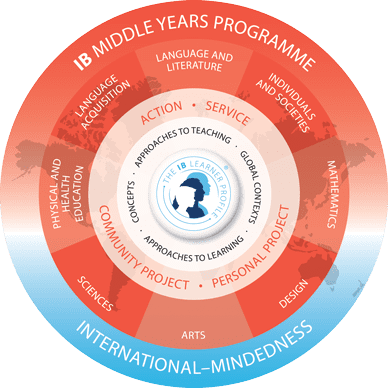
This acceleration ensures the Ontario Ministry science curriculum is covered efficiently while creating room to introduce the four branches of the MYP sciences framework:
The first branch, Knowing and Understanding, involves mastering core scientific concepts across biology, chemistry, and physics and applying them to solve problems in both familiar and unfamiliar contexts. The second branch, Inquiring and Designing, requires students to formulate research questions, develop hypotheses, and design controlled experiments with appropriate variables and methodology. The third branch, Processing and Evaluating, focuses on collecting, organizing, and interpreting data, identifying sources of error, and evaluating the validity and reliability of results. The fourth branch, Reflecting on the Impacts of Science, asks students to examine how science and its applications interact with ethical, social, economic, and environmental considerations.
Understanding the IB MYP 1 to 8 Assessment Criteria in Science
The most significant adjustment for students entering a Pre IB science classroom is the shift in assessment methodology. Work is not graded on standard percentages. Instead, performance is evaluated across four equally weighted criteria, each scored on a rubric with achievement levels from 1 to 8.
Criterion A, Knowing and Understanding, assesses a student’s ability to recall and apply scientific knowledge to solve problems, including complex scenarios presented in unfamiliar formats.
Support Focus: Helping students connect core biological, chemical, and physical concepts when questions are framed in novel or application based ways.
Criterion B, Inquiring and Designing, evaluates a student’s capacity to independently develop scientific questions, formulate testable hypotheses, and design rigorous experimental procedures.
Support Focus: Walking students through the logical structure of a scientific inquiry, from identifying variables to selecting appropriate methodology.
Criterion C, Processing and Evaluating, examines how students collect and interpret data, identify experimental limitations, and assess whether their conclusions are well supported by evidence.
Support Focus: Reviewing lab reports for analytical depth, proper data presentation, and the quality of evaluative commentary.
Criterion D, Reflecting on the Impacts of Science, requires students to consider the broader implications of scientific work and communicate how science connects to real world issues and ethical questions.
Support Focus: Teaching students to construct well reasoned responses that move beyond content recall into genuine scientific reflection.
The Role of Supplemental Support
The scientific concepts and inquiry skills developed in Grade 9 and Grade 10 form the foundation for the senior IB Diploma Programme sciences in Grades 11 and 12. The mathematical skills developed alongside science in MYP Year 4 are equally foundational. Students who find themselves stretched across both subjects at once often benefit from coordinated support in science and Grade 9 IB Math simultaneously. While a tutor can clarify difficult concepts, untangle rubric expectations, and strengthen a student’s lab report writing and data analysis, sustained success in the IB science pathway depends on the student’s own study habits, independent practice, and engagement with the material between sessions.
Our Grade 9 IB Science Tutoring: Personalized Support for Ontario Students
For students adjusting to the pace and expectations of IB World Schools across York Region and Ontario, the MYP science criteria can initially feel counterintuitive. Supplemental tutoring for Grade 9 IB Science provides targeted feedback on lab reports and assignments, clarifies confusing classroom concepts, and teaches students how to interpret and respond to their evaluation rubrics with confidence.
Contact York Region Tutoring today to learn more about our academic support for the Grade 9 IB Science curriculum and how students can build the foundational skills needed for Grade 10 IB Science and beyond.
Grade 9 IB Science Curriculum Breakdown
Students examine the relationships between living organisms and their environments, exploring how energy flows through food webs, how human activity affects ecosystem health, and why biodiversity matters for long term ecological stability.
Students investigate the structure and function of plant and animal cells, including organelles, cell division, and the basic biological processes that sustain life at the cellular level.
Students explore the building blocks of matter, learning how atoms combine to form elements and compounds, how to read and interpret the periodic table, and how chemical formulas represent molecular structures.
Students study how substances interact and transform, covering types of chemical reactions, balancing equations, and understanding the observable signs that a chemical change has occurred.
Students learn to classify substances on the pH scale, investigate the properties of acids and bases, and explore neutralization reactions and their real world applications.
Students examine the principles of static and current electricity, including charge, voltage, resistance, and current, and apply Ohm’s Law to analyze series and parallel circuits.
Students investigate the structure of the solar system, the life cycle of stars, the scale of the universe, and current scientific understanding of how the universe formed and continues to evolve.
York Region Tutoring Provides
If a student is approaching a forthcoming test, we can provide them with a previous test to be completed at home before their upcoming session. Subsequently, during their next class, just before the exam, they can review the test with their tutor. These tests are exclusively sourced from high schools in York Region and other areas in Ontario, serving as the definitive benchmark for students to assess their readiness.
York Region Tutors and are equipped with drawing tablets making collaboration simple, efficient and effective. We also offer drawing tablets at a discount for purchase to students who really take to the functionality of the product.
At the parents’ request, following each tutoring session, our tutors can assign homework tailored to address weaknesses and reinforce strengths in students. Additionally, we incorporate homework questions directly extracted from previous tests and quizzes administered by YRDSB school teachers, allowing students to familiarize themselves with potential test questions.