
Grade 12 Math (College/Workplace)
Overview of Grade 12 Math (College/Workplace)
Navigating Grade 12 Math in Ontario: College vs. Workplace Pathways
When high school students enter their final year in Ontario, the pressure to choose the right academic pathway can feel overwhelming. A common misconception is that university-bound courses like Calculus or Advanced Functions are the only math credits that matter. In reality, Ontario’s curriculum features three highly targeted, specialized Grade 12 math courses designed for students heading straight into college or the workforce.
Choosing the right course depends entirely on your post-secondary plans. Let’s break down Ontario’s three senior non-university math pathways—MAP4C, MCT4C, and MEL4E—to help you align your high school credits with your future career goals.
1. MAP4C: Foundations for College Mathematics (MAP4C)
For students eyeing a standard college diploma, a certified trade, or an administrative career, MAP4C is usually the go-to requirement. This course bridges abstract high school algebra with the practical math used in day-to-day business operations and personal living.
-
What you will learn: The curriculum is heavily rooted in real-world application. Students explore financial mathematics (including annuities, budgeting, and the costs of renting vs. buying a home), data management, statistics, and practical geometry/trigonometry.
-
Who it is for: MAP4C is ideal for students pursuing college programs in business, health sciences, human services, and many skilled trades.
-
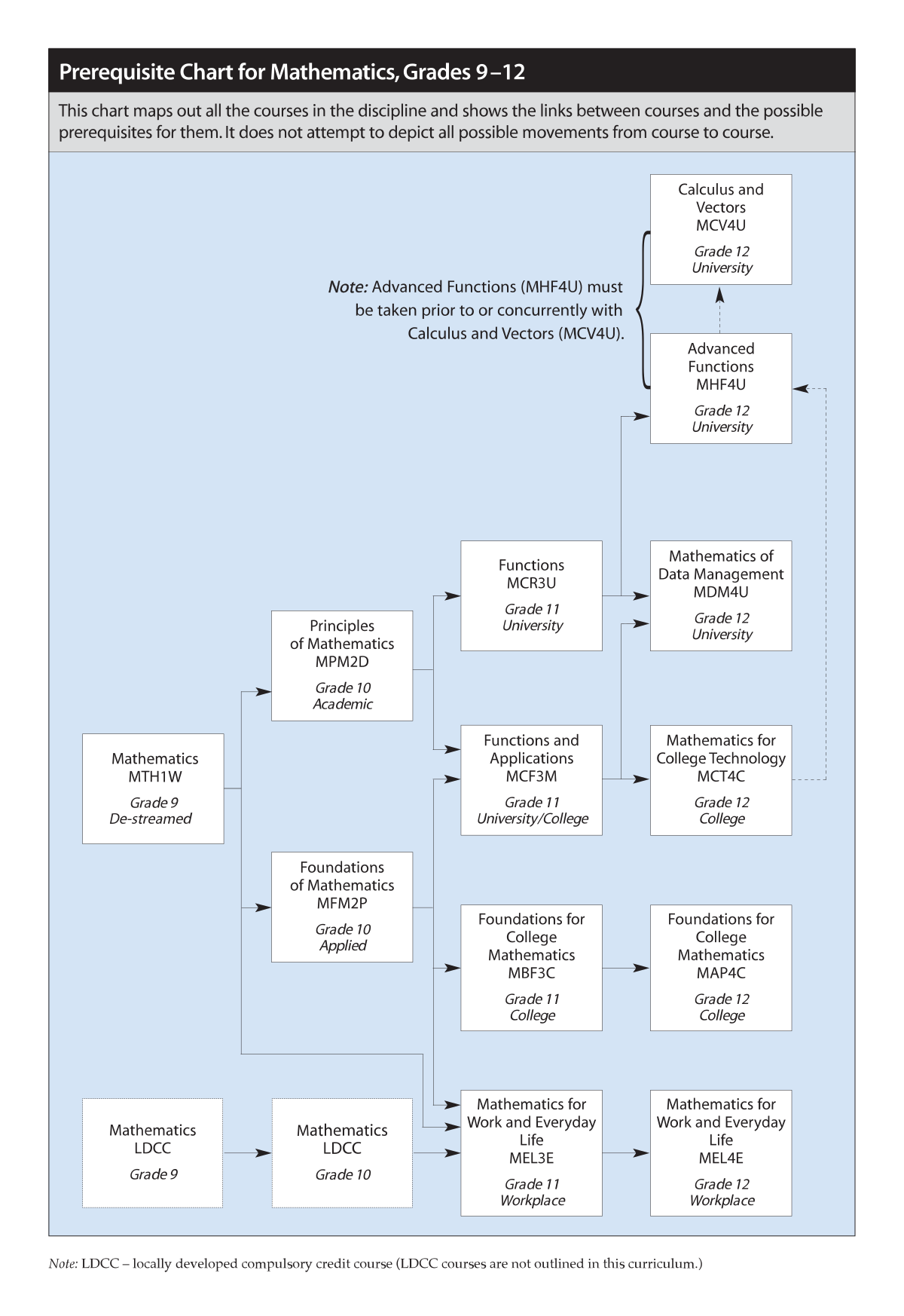
Prerequisites: Grade 11 Foundations for College Mathematics (MBF3C) or Grade 11 Functions and Applications (MCF3M).
2. MCT4C: Mathematics for College Technology (MCT4C)
If you have your sights set on a highly technical college program, MCT4C is the key that unlocks those doors. It is significantly more abstract and rigorous than MAP4C because it is explicitly designed to prepare students for calculus-adjacent math in technical fields.
-
What you will learn: Rather than focusing on budgets and taxes, MCT4C focuses on extending your knowledge of functions. You will investigate polynomial, exponential, and trigonometric functions, alongside advanced geometry and vector-style applications.
-
Who it is for: This is a mandatory requirement for competitive college programs in engineering technology, computer programming, aviation, architecture, and advanced technician fields. If you excel at algebra but prefer a college hands-on pathway over a university lecture hall, this is your course.
-
Prerequisites: Grade 11 Functions (MCR3U) or Grade 11 Functions and Applications (MCF3M).
3. MEL4E: Mathematics for Work and Everyday Life (MEL4E)
For students planning to transition immediately into the workforce after graduation, or those pursuing specific apprenticeships that do not require complex algebra, MEL4E offers the ultimate survival toolkit for adult life.
-
What you will learn: This course completely strips away theoretical equations to focus entirely on life skills. Students learn how to prepare a personal income tax return, analyze workplace statistics, apply basic probability, use proportional reasoning for measurements, and master household budgeting.
-
Who it is for: MEL4E is designed for students entering direct employment or specific workplace-destined apprenticeships. It ensures graduates can confidently manage their own money and navigate math-related tasks on a job site.
-
Prerequisites: Grade 11 Mathematics for Work and Everyday Life (MEL3E).
Summary: Which Path Should You Choose?
| Course Code | Pathway Destination | Core Focus | Ideal For |
| MAP4C | College / General Trades | Financial literacy, basic statistics, and practical geometry. | Business, Health Sciences, Nursing, Marketing. |
| MCT4C | Technical College Degrees | Advanced algebra, trigonometry, and complex functions. | Engineering Technology, Computer Science, Architecture. |
| MEL4E | Direct Workplace / Specific Apprenticeships | Household budgeting, income tax, and everyday measurements. | Immediate workforce entry, retail management, entry-level trades. |
Final Verdict: Check Before You Select
Before submitting your course selections, always look ahead. Visit ontariocolleges.ca or check the specific admission requirements for the programs or apprenticeships you want to pursue. Picking the right Grade 12 math credit ensures you don’t just graduate, but step into your next chapter completely prepared.
Ontario Curriculum Breakdown - Grade 12 College/Workplace
This course bridges the gap between high school algebra and practical college-level application. Students focus heavily on how math functions in consumer and professional environments.
-
-
Mathematical Models: Students learn how to work with exponents, manipulate algebraic formulas, and interpret complex data graphs to solve real-world problems.
-
Personal Finance: Covers the actual mechanics of adulthood finance. Students learn how to calculate compounding annuities, evaluate mortgage options, contrast the real costs of renting vs. buying, and design functional household budgets.
-
Geometry and Trigonometry: Focuses on spatial reasoning. Students use trigonometry like the Sine and Cosine laws to solve measurement problems and learn optimization, which is calculating how to maximize area while minimizing perimeter or materials.
-
Data Management: Students learn how to collect data, find a line of best fit on a scatter plot, analyze statistical correlation, and critically evaluate the statistics they see in the media.
-
This is a highly algebraic, rigorous course designed to build the theoretical foundations needed for engineering, computer science, and technical programs.
-
Polynomial Functions: Students learn to identify, graph, factor, and solve problems using polynomial equations and formulas.
-
Exponential and Logarithmic Functions: Covers exponential growth and decay models. Students are introduced to logarithms, learning how to use them to solve complex exponential equations.
-
Trigonometric Functions and Periodic Behaviour: Students look past simple triangles to study periodic waves. They learn to graph and transform sine and cosine functions to model real-world oscillating systems like sound waves or rotating machinery.
-
Applications of Geometry and Vectors: Students are introduced to the basics of vectors, which are quantities with both magnitude and direction, vector addition and subtraction, advanced circle geometry, and multi-dimensional volume calculations.
This course strips away theoretical formulas entirely, operating as a life skills math class designed to prepare students for financial independence and immediate entry into the workforce.
-
Personal Finance and Taxes: Students learn the practical math required to rent an apartment, calculate moving costs, track ongoing living expenses, and physically fill out and file a personal Canadian income tax return.
-
Measurement Systems: Focuses heavily on practical job-site skills. Students learn to master both the Metric and Imperial systems, convert measurements seamlessly between the two, and accurately estimate dimensions.
-
Proportional Reasoning: Students apply ratios, rates, and scales to real-world tasks. This includes interpreting blueprint scale drawings and using proportions to calculate things like materials for a home improvement project or workplace inventory.
-
Reasoning with Data and Probability: Teaches students how to read, interpret, and display workplace data, understand basic probability, and spot how data is manipulated in media and advertising.
York Region Tutoring Provides
If a student is approaching a forthcoming test, we can provide them with a previous test to be completed at home before their upcoming session. Subsequently, during their next class, just before the exam, they can review the test with their tutor. These tests are exclusively sourced from high schools in York Region and other areas in Ontario, serving as the definitive benchmark for students to assess their readiness.
York Region Tutors and are equipped with drawing tablets making collaboration simple, efficient and effective. We also offer drawing tablets at a discount for purchase to students who really take to the functionality of the product.
At the parents’ request, following each tutoring session, our tutors can assign homework tailored to address weaknesses and reinforce strengths in students. Additionally, we incorporate homework questions directly extracted from previous tests and quizzes administered by YRDSB school teachers, allowing students to familiarize themselves with potential test questions.