
Grade 10 IB Math Tutoring (MYP Year 5)
Overview of Grade 10 IB Math Tutoring (MYP Year 5)
The final year of the International Baccalaureate Middle Years Programme marks a natural transition phase for students preparing for senior secondary education. Grade 10 Pre IB Math is officially classified as MYP Year 5. For families seeking Grade 10 IB math tutoring, this pivotal year focuses on consolidating foundational math skills while introducing more abstract, multi step problem solving concepts.
Rather than just repeating mechanical operations, Grade 10 MYP students learn to deepen their mathematical reasoning and apply core concepts to complex, unfamiliar contexts.
This stage presents an important growth period for students. As the coursework evolves, problems require more independent analysis. Grade 10 IB Math tutoring at this stage focuses on refining a student’s technical precision, helping them master algebraic and geometric foundations, and building the study habits needed for the senior Diploma Program.
Personalized Grade 10 IB Math Tutoring: Blending Ontario MPM2D with IB MYP Year 5 Foundations
In Ontario public and Catholic school boards, standard Grade 10 students follow the MPM2D Academic curriculum. In a Pre IB or IB preparation classroom, schools condense and accelerate this material, often combining Ontario Grade 10 concepts with crucial Grade 11 Functions material within the same academic calendar.
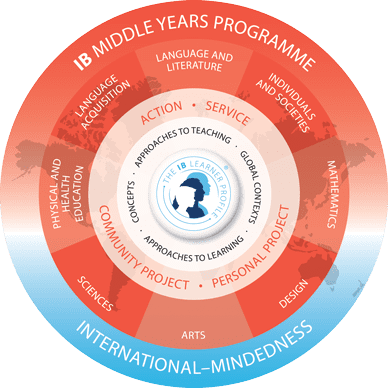
This rapid pacing ensures that students complete their OSSD prerequisites early, leaving sufficient time to cover the advanced topics required by the four core branches of the IB MYP Year 5 mathematics framework:
- Numerical and Abstract Reasoning: Advanced polynomial factoring, non linear systems, radical equations, and working fluently with complex rational expressions.
- Thinking with Models: Deep exploration of quadratic functions in standard, vertex, and factored forms, alongside an introduction to exponential functions and logarithmic concepts.
- Spatial Reasoning: Advanced coordinate geometry, circle theorems, geometric proofs, and expanding right angle trigonometry into non right triangles using the Sine Law and Cosine Law.
- Reasoning with Data: Complex probability structures, conditional probability, standardized data distributions, and evaluating the validity of statistical studies.
Understanding the IB MYP 1 To 8 Assessment Criteria
Assessment in Grade 10 Pre IB Math continues to rely on the specialized four criteria rubrics rather than standard percentage tracking. However, the grading descriptors for MYP Year 5 demand a much higher level of mathematical maturity, abstract thought, and critical evaluation.
Teachers evaluate student progress using four distinct rubrics, each scaled from 1 to 8:
Criterion A: Knowing and Understanding
Students must demonstrate consistent accuracy in executing complex mathematical operations. Assessments include multi step, non routine problems presented in entirely unfamiliar setups that test the limits of a student’s conceptual knowledge.
-
Support Focus: Training students to break down sophisticated exam questions into foundational algebraic or trigonometric steps, ensuring technical accuracy under timed conditions.
Criterion B: Investigating Patterns
Students are tasked with unpredictable mathematical investigations where they must identify complex relationships, describe unexpected anomalies in data patterns, and formulate comprehensive general rules or mathematical theorems.
-
Support Focus: Guiding students through advanced inquiry strategies so they can confidently hypothesize, test, and formally justify general mathematical laws.
Criterion C: Communicating
This criterion assesses the layout, clarity, and professionalism of a student’s written math work. Grade 10 students are expected to use precise mathematical terminology, flawless notation, correct symbols, and fluidly transition between algebraic equations, geometric diagrams, and explanatory text.
-
Support Focus: Reviewing written solutions line by line to ensure students structure their work logically, avoid notation errors, and satisfy the rigorous requirements of the communication rubric.
Criterion D: Applying Mathematics in Real Life Contexts
Students must analyze authentic, real world scenarios by translating complex situational variables into mathematical models. They are required to design appropriate problem solving paths, reach definitive solutions, and critically reflect on the real world constraints and accuracy of their results.
-
Support Focus: Coaching students through dense, context heavy word problems, teaching them how to extract essential mathematical data, and helping them write the reflective critiques required for top marks.
The curriculum mastered in Grade 10 forms the absolute prerequisite for both senior Diploma Program pathways: Analysis and Approaches or Applications and Interpretation. While a tutor can illuminate complex concepts, clarify rubric expectations, and refine mathematical execution, long term success in the senior IB years relies on the student’s personal work ethic, independent study habits, and daily practice.
Grade 10 IB Math Tutoring: Personalized Support for Ontario Students
For students adapting to the swift pacing and elevated standards of local IB World Schools within York Region and Ontario, navigating the Year 5 expectations can feel demanding. Supplemental tutoring acts as a reliable academic sounding board, offering targeted feedback on homework presentation, clarifying abstract mathematical functions, and teaching students how to systematically address the specific demands of their evaluation rubrics.
Contact York Region Tutoring today to learn more about our academic support and how Grade 10 IB math tutoring can help students build the foundational skills needed for senior Diploma Program math.
Grade 10 IB Math Curriculum Breakdown
This branch focuses on complex algebraic manipulations, expanding a student’s capacity to handle highly abstract number fields and radical expressions.
- Complex Radical Operations: Simplifying and evaluating radical expressions, multiplying multi term radicals, and rationalizing the denominator containing a surd or radical variable.
- Advanced Algebraic Factoring: Factoring complex quadratic trinomials, grouping terms, handling differences of squares, and simplifying multi step rational expressions.
- Fractional and Negative Exponents: Mastery of the laws of exponents applied across fractional and rational systems, laying foundations for exponential behavior.
- Introduction to Logarithms: Understanding the relationship between index notation and logarithmic form, utilizing the laws of logarithms to simplify expressions.
- Inequalities: Solving, graphing, and representing compound and double linear inequalities on number lines.
Students use functions and modeling techniques to analyze linear and non linear behavior, with a heavy emphasis on the properties of quadratic expressions.
- Quadratic Functions: Navigating fluidly between standard form and factored form.
- Parabolic Analysis: Locating and interpreting key features of a parabola including the axis of symmetry, vertex coordinates, maximum or minimum values, and intercept zones.
- Non Linear Systems: Solving simultaneous systems of equations algebraically and graphically, including linear quadratic intersections.
- Sequences and Series: Formulating, testing, and verifying general algebraic rules for both arithmetic and geometric progressions.
This branch links algebraic formulas to physical space, covering multi dimensional coordinate geometry, circle theorems, and advanced triangle geometry.
- Advanced Analytic Geometry: Calculating midpoints, line segment lengths, slopes, and equations of lines, with specific focus on gradients of parallel and perpendicular paths.
- Circle Theorems and Properties: Examining angles subtended by arcs, chord lengths, radius properties, and the geometric behavior of tangent lines to a circle.
- Non Right Angle Trigonometry: Moving beyond basic primary ratios to calculate missing sides and angles in oblique triangles using the Sine Law and Cosine Law.
- Three Dimensional Measurement: Optimizing surface area, volume, and net structures for complex three dimensional shapes like cones, spheres, pyramids, and compound figures.
Students explore the mathematical tools needed to extract meaning from complex sets of numbers, evaluate trends, and calculate probability limits.
- Dispersion Measures: Analyzing data patterns by calculating the range, quartiles, percentiles, interquartile range (IQR), and standard deviation.
- Advanced Data Representation: Constructing and evaluating data summaries via continuous class interval histograms, cumulative frequency tables, and boxplots.
- Bivariate Data and Correlation: Building scatter diagrams to identify weak or strong positive and negative trends, alongside calculating lines of best fit.
- Conditional Probability: Using sample spaces, Venn diagrams, and multi stage tree diagrams to evaluate dependent, independent, mutually exclusive, and conditional probability events.
York Region Tutoring Provides
If a student is approaching a forthcoming test, we can provide them with a previous test to be completed at home before their upcoming session. Subsequently, during their next class, just before the exam, they can review the test with their tutor. These tests are exclusively sourced from high schools in York Region and other areas in Ontario, serving as the definitive benchmark for students to assess their readiness.
York Region Tutors and are equipped with drawing tablets making collaboration simple, efficient and effective. We also offer drawing tablets at a discount for purchase to students who really take to the functionality of the product.
At the parents’ request, following each tutoring session, our tutors can assign homework tailored to address weaknesses and reinforce strengths in students. Additionally, we incorporate homework questions directly extracted from previous tests and quizzes administered by YRDSB school teachers, allowing students to familiarize themselves with potential test questions.