
Grade 11 IB Physics Tutoring (SL/HL) DP Year 1
Overview of Grade 11 IB Physics Tutoring (SL/HL) DP Year 1
Grade 11 IB Physics Tutoring: Ontario DP Year 1 Course Support
The transition into the official International Baccalaureate Diploma Programme introduces a significant shift in academic pacing and conceptual depth. Grade 11 IB Physics represents the first year of this rigorous pre-university science pathway. For local families navigating this adjustment, Grade 11 IB Physics tutoring provides a structured sounding board to manage accelerated content, master foundational experimental skills, and maintain competitive averages for university admissions.
Rather than treating physics as a series of memorized formulas, the IB physics curriculum expects students to reason from first principles, design and evaluate experiments, and communicate scientific ideas with technical precision. Many capable students hit a wall in Grade 11 because their existing study habits rely on formula recall rather than genuine conceptual understanding. Our approach to Grade 11 IB Physics tutoring focuses on building that deeper fluency, helping students transition smoothly from standard high school science into the analytical demands of the Diploma Programme.
The First Year: Ontario SPH3U7 and the IB Framework
In public and Catholic IB World Schools across York Region and Ontario, Grade 11 students operate on a fluid, integrated schedule that blends the provincial curriculum with the international syllabus. On an Ontario report card, the first year of senior IB physics is typically coded as SPH3U7 (Grade 11 Physics, University Preparation), building on the standard SPH3U expectations.
Because IB classrooms must prepare students for standardized international examinations at the end of Grade 12, schools condense the baseline Ontario Ministry curriculum and use the time gained to introduce material from the international syllabus early. This means a Grade 11 IB Physics student will often encounter measurement uncertainty analysis, vector-based mechanics, and thermal physics concepts in far greater depth than their peers in a standard Ontario stream, well before the course officially requires it.
Our IB Physics tutoring framework supports both official levels established by the International Baccalaureate organization, addressing the practical differences between Standard Level and Higher Level expectations from day one of the Diploma Programme.
Understanding SL vs. HL in Grade 11
Unlike IB Math, which splits into two distinct pathways, IB Physics is a single course offered at two levels of depth. The distinction that matters most for families is workload and pacing, not subject matter choice.
Physics Standard Level (SL): SL students cover the core syllabus at a pace appropriate for students who intend to use physics as a supporting science credit rather than pursue it at the university level. The content is rigorous but manageable, and SL Physics aligns well with Ontario entrance requirements for Life Sciences, Health Sciences, and many Business or Social Science programs that request a Grade 11 or 12 science credit.
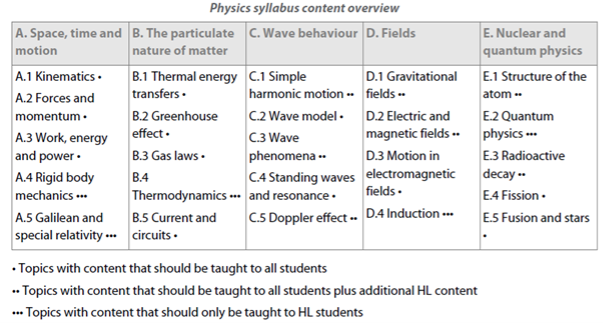
Physics Higher Level (HL): HL Physics is built for students heading toward engineering, physics, computer science, or other quantitative university programs. Alongside the full core syllabus, HL students tackle additional depth in mechanics, fields, and quantum concepts, supported by a noticeably heavier mathematical toolkit, including vector decomposition, calculus-based reasoning, and more rigorous graphical analysis. The IB Diploma Programme allocates 150 total classroom hours to SL Physics across the two-year programme, compared with 240 hours for HL, a 60% increase in depth delivered on the same school calendar. Grade 11 is where that gap first becomes noticeable.
Our Grade 11 IB Physics tutoring is structured to support students at either level, with HL sessions calibrated to the additional mathematical rigor those students face from the very first unit.
Core Topics Covered in Grade 11 IB Physics
DP Year 1 lays the experimental and conceptual groundwork that both SL and HL students carry into Grade 12. Our York Region tutors provide targeted support across each of the following areas.
1. Measurement and Uncertainty
This foundational unit sets the tone for how IB expects students to think about data for the rest of the Diploma Programme: distinguishing between systematic and random error, propagating uncertainty through calculations, applying correct significant figures, and interpreting error bars and lines of best fit on graphs.
2. Mechanics
Mechanics forms the backbone of the Grade 11 syllabus and introduces the vector-based reasoning that carries through the entire programme: analyzing motion using kinematics equations and displacement-time, velocity-time, and acceleration-time graphs; applying Newton’s Laws to systems involving multiple forces and friction; and working through momentum, impulse, and energy transformation problems, including elastic and inelastic collisions.
3. Thermal Physics
Thermal physics introduces students to particle-level reasoning about macroscopic phenomena: applying the kinetic model of matter to explain temperature, pressure, and phase change; working through specific heat capacity and latent heat calculations; and applying the ideal gas laws to relate pressure, volume, and temperature in closed systems.
4. Waves
Wave behaviour bridges mechanics and the electromagnetic concepts introduced later in the programme: describing wave properties including wavelength, frequency, amplitude, and speed; distinguishing between transverse and longitudinal waves; and analyzing reflection, refraction, diffraction, and superposition, including an introduction to standing waves.
5. Foundational Experimental Skills
Beyond content knowledge, Grade 11 is where the IB’s Practical Scheme of Work begins in earnest, requiring students to design controlled experiments, identify and justify variables, and produce lab reports that meet the IB’s expectations for scientific communication, skills that become essential once the Internal Assessment begins in Grade 12.
Building Toward the Internal Assessment
While the formal Internal Assessment, an independent scientific investigation worth 20% of the final IB grade, is typically completed in Grade 12, the habits that determine its success are built in Grade 11. Students who leave DP Year 1 with strong practical technique, comfortable error analysis, and confident graphing skills consistently produce stronger investigations the following year.
Our Grade 11 IB Physics tutoring program lays this groundwork directly:
- Lab Report Technique: Coaching students on structuring methodology, presenting raw and processed data clearly, and writing conclusions that are properly supported by their results.
- Error and Uncertainty Analysis: Ensuring students can propagate uncertainty correctly and discuss the limitations of their experimental design with appropriate scientific language.
- Data Presentation: Building fluency with graphing conventions, including appropriate scales, error bars, and lines of best fit, so these skills are second nature by the time the IA begins.
Why Expert Support Makes the Difference in Grade 11
Grade 11 IB Physics moves quickly, and gaps that form early tend to resurface in Grade 12, when the syllabus turns to fields, quantum physics, and the more mathematically demanding HL extensions. Our personalized approach to Grade 11 IB Physics tutoring delivers targeted, practical support exactly when it matters most:
- Concept Reinforcement: Revisiting classroom material through worked examples and guided practice so students build genuine understanding rather than short-term memorization.
- Mathematical Support: Strengthening the vector algebra, graphing, and calculus-adjacent reasoning that HL Physics in particular demands, often before the classroom has caught up to a student’s math course.
- Exam Technique: Familiarizing students with IB command terms such as “state,” “calculate,” “explain,” and “evaluate,” and teaching them how mark schemes reward each type of response.
- Gap Identification: Diagnosing the specific Grade 10 science concepts that remain unstable and addressing them directly before they compound in Grade 12. Students managing both math and science workloads in Grade 11 may also benefit from our Grade 11 IB Math Tutoring page for coordinated DP Year 1 support.
The experimental habits, mathematical fluency, and exam discipline developed in Grade 11 shape how comfortably a student handles the far more demanding Grade 12 syllabus, including fields, quantum and nuclear physics, and the HL-exclusive option topics.
Grade 11 IB Physics Tutoring: Personalized Support for Ontario Students
For families managing the demands of IB World Schools across York Region and the surrounding communities, Grade 11 is the year to build strong foundations rather than hope gaps resolve themselves in Grade 12. The syllabus only accelerates from here, and the practical skills introduced this year underpin everything from lab reports to the eventual Internal Assessment.
Supplemental tutoring provides specific, criteria-aligned feedback on lab work and problem sets, clarifies abstract concepts that classroom pace does not allow time to revisit, and equips students with the strategic and technical tools they need to enter Grade 12 with genuine confidence.
Contact York Region Tutoring today to learn more about our academic support and discover how targeted Grade 11 IB Physics tutoring can help your child build the foundation their Diploma Programme success requires.
International Baccalaureate (IB) Diploma Programme (DP) Physics Pathways Explained
-
Overview: A rigorous exploration of core physics principles—including mechanics, thermal physics, and waves—designed to balance top-tier scientific literacy with GPA optimization.
-
Hours: 150 classroom hours (2-year delivery).
-
Destination Programs: Life Sciences, Health Sciences, Pre-Med, Kinesiology, and Architecture.
-
Ontario University Alignment: Meets the Grade 11/12 Physics prerequisite requirement for almost all non-engineering science majors.
IB Physics – Higher Level (HL)
-
Overview: An elite, fast-paced course that builds on the core syllabus with advanced mathematical modeling, deep theoretical extensions, and complex problem-solving.
-
Hours: 240 classroom hours + extended practical scheme of work.
-
Destination Programs: Mandatory for tier-one Engineering, Computer Science, Physics, and specialized physical sciences.
-
Core Advanced Topics: Quantum/nuclear physics, thermodynamics, fields (gravitational and electrostatic), and electromagnetic induction.
York Region Tutoring Provides
If a student is approaching a forthcoming test, we can provide them with a previous test to be completed at home before their upcoming session. Subsequently, during their next class, just before the exam, they can review the test with their tutor. These tests are exclusively sourced from high schools in York Region and other areas in Ontario, serving as the definitive benchmark for students to assess their readiness.
York Region Tutors and are equipped with drawing tablets making collaboration simple, efficient and effective. We also offer drawing tablets at a discount for purchase to students who really take to the functionality of the product.
At the parents’ request, following each tutoring session, our tutors can assign homework tailored to address weaknesses and reinforce strengths in students. Additionally, we incorporate homework questions directly extracted from previous tests and quizzes administered by YRDSB school teachers, allowing students to familiarize themselves with potential test questions.